
 Reviews
 Why Posture Matters More Than You Think (and What Your Nervous System Has to Do With It)
Posture is more than a cue on a yoga mat or a reminder from your chiropractor — it’s a neurological output that reflects how your brain, muscles, and spinal alignment are working together.
When posture doesn’t improve — even after stretching, strengthening, or ergonomic adjustments — it’s often because the nervous system has adapted to a pattern that feels “normal” to your body, even if it’s causing pain or dysfunction.
In this article, we’ll explain the science behind posture, why traditional exercises alone often don’t lead to lasting changes, and how a neurologically-based approach can help. Contact Koru today to see how your posture could be affecting you.
How the Nervous System Controls Posture
Your posture isn’t something you consciously decide to “keep” every minute of the day — it’s regulated by your nervous system through sensory feedback from multiple sources:
- Vision
- Inner ear balance mechanisms
- Cervical spine proprioception (joint position sense)
The neck, in particular, has a dense network of sensory receptors that feed information to the brain about head and body position. When this information is accurate and coordinated, the body maintains efficient posture and balance. When it’s disrupted, the nervous system begins to treat that altered alignment as normal, and your posture stays stuck in that pattern.
Research has shown that cervical proprioception — the sense of where your head and neck are in space — is crucial for postural control and balance, and that impairment in this system is associated with neck pain, postural instability, and diminished overall control of alignment.
In fact, people with impaired joint position sense in the neck demonstrate significant challenges with postural stability when compared with healthy individuals.
Forward Head Posture: More Than “Just Bad Posture”
Forward head posture (FHP) — where the head sits forward relative to the shoulders — isn’t just a visual issue. It’s linked to a variety of sensorimotor and balance deficits:
- Altered proprioceptive feedback from cervical muscles
- Changes in the limits of stability and balance control
- Compensatory muscular patterns that reinforce the posture
A review of studies found that people with FHP have measurable changes in proprioception and postural control compared with people without FHP.
These altered signals mean the nervous system is receiving conflicting inputs about where the head actually is. This creates a mismatch between how the brain thinks your body is aligned and how it actually is aligned.
This mismatch can also influence sensorimotor control and even autonomic nervous system responses. Participants with FHP showed altered sensorimotor control and autonomic function. Compared with those with neutral head alignment, suggesting widespread effects beyond just posture itself.
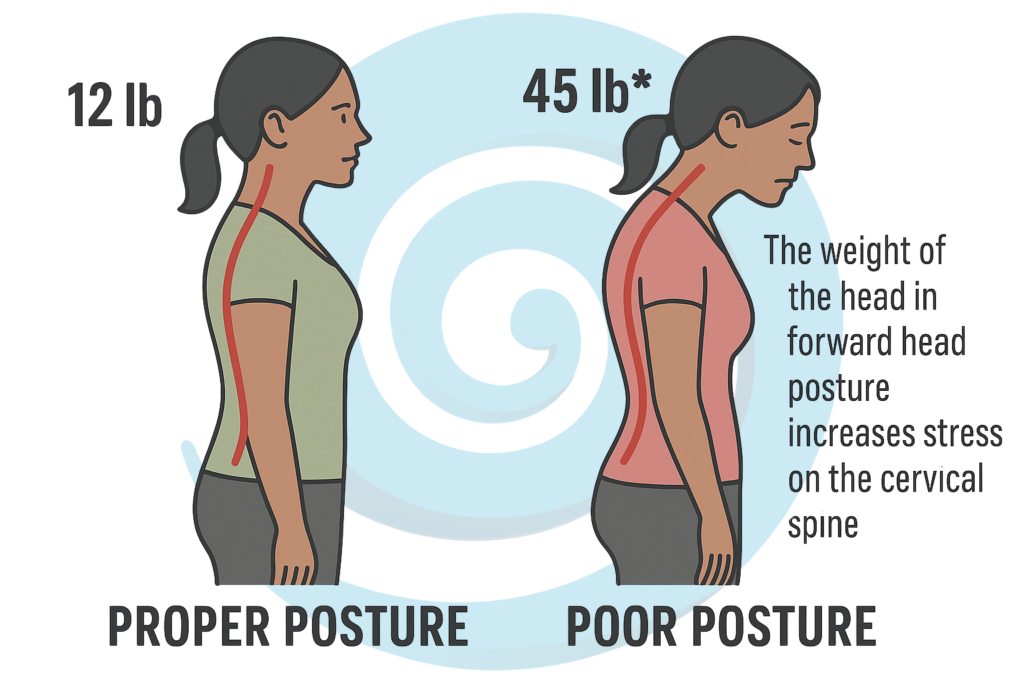
Why Traditional Posture Improvements Don’t Always Hold
You may have tried:
- Stretching your chest and hips
- Strengthening your core or neck flexors
- Sitting tall with reminders
- Ergonomic workstations
And seen good short-term results… until the posture slipped back.
That’s because these approaches don’t directly address the neurological pattern your nervous system has learned over time.
The cervical spine heavily influences balance and postural stability. When neck muscles and proprioceptive input are inconsistent due to misalignment or chronic stress, the nervous system can’t reliably tell your brain where your head and body should be in space.
Interventions that focus only on muscles or strength without retraining the sensory accuracy of the neck are unlikely to create lasting changes in how posture is regulated.
Evidence for Sensorimotor Retraining
Emerging research suggests that proprioceptive and sensorimotor training for the cervical region can improve postural control and balance.
For example, cervical stabilization exercises — particularly those designed to improve proprioception and neuromuscular control — have shown promise in improving balance and posture in people with forward head posture.
Additionally, studies examining dynamic postural stability in people with chronic neck pain found that those with neck issues show poorer balance compared with healthy controls — underscoring the central role of cervical input in controlling posture
A Neurologically-Informed Approach to Posture
At Koru Chiropractic, we don’t treat posture as a set of muscles you need to force into place.
Instead, we treat posture as a neurological pattern — one that can be measured, understood, and corrected by improving the clarity of sensory input to the brain.
Here’s how that looks in practice:
- Posture and neurological assessment — We evaluate alignment and proprioceptive function, not just strength or flexibility.
- Gentle, specific corrections — Adjustments designed to improve how the nervous system perceives head and neck position.
- Sensorimotor enhancement — Exercises and guidance that help reestablish accurate neurological feedback.
This approach goes beyond temporary relief — it targets the patterns that lead to long-term postural adaptation.
Real-World Importance of Posture
Better posture isn’t just about aesthetics or standing tall on command. It can influence:
- Headache frequency and intensity
- Neck pain and stiffness
- Balance and fall risk
- Nervous system efficiency
- Breath mechanics and muscular coordination
When your nervous system gets clearer information about your alignment, posture often improves naturally — without force, strain, or constant conscious effort.
Your Next Step Toward Clarity and Change
If you’ve been working on posture for a long time without lasting success, you might be approaching it from the wrong level — at the muscle level instead of the neurologic level. At Koru Chiropractic, we help people understand how their posture is linked to nervous system function — and how addressing that connection can lead to real, long-lasting change.