
 Reviews
 What to Expect at Your First Visit to Koru Chiropractic in Louisville, Colorado
A lot of people delay care for one simple reason: they do not know what to expect on the first visit.
That hesitation makes sense. Most people do not want to walk into a healthcare office feeling unsure, pressured, or confused about what will happen next. In neck pain care, careful history-taking and physical examination are central to good decision-making, while imaging has a more selective role depending on the clinical picture.
At Koru Chiropractic in Louisville, Colorado, the goal of the first visit is clarity. That starts with listening, continues with a thoughtful evaluation, and leads to a recommendation that fits the patient rather than a one-size-fits-all process. Evidence-informed chiropractic best-practice guidance also emphasizes history, examination, diagnosis, informed consent, co-management or referral when needed, and patient-centered care planning.
Why Patients Often Wait to Book
Many patients are not against care. They are against uncertainty.
They want to know:
- What is going to happen?
- Will anyone actually listen?
- Will I be pressured into treatment?
- Will I be adjusted on the first visit?
- Will I need imaging?
- Will I leave with a clear plan?
Those are reasonable questions. In musculoskeletal care, shared decision-making is valued in part because it improves communication and helps patients form more accurate expectations about treatment.
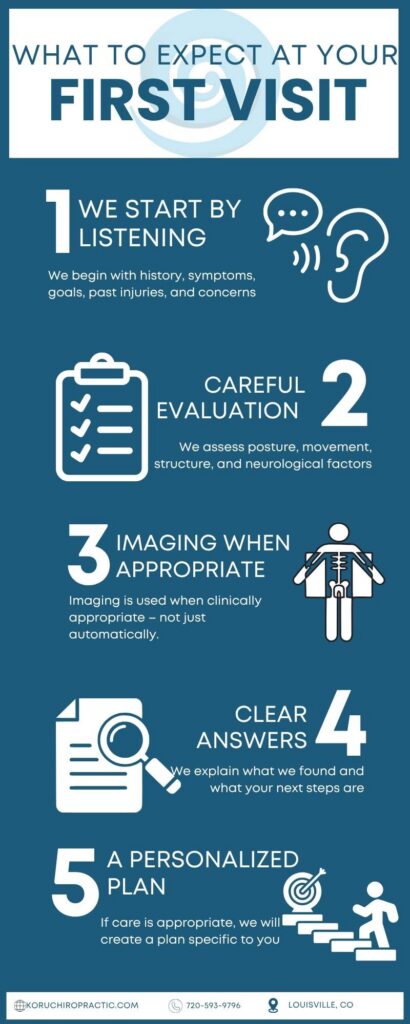
Step 1: We Start With Your History
The first visit begins with your story.
That usually includes:
- what you are feeling
- when it started
- how it has changed over time
- what makes it better or worse
- past injuries
- prior treatment
- your goals
- your concerns
This matters because an accurate history is one of the most important parts of evaluating neck pain and related symptoms. Physical examination helps refine what is learned from the history, but the history often drives the most important diagnostic clues.
Step 2: A Careful Examination
After the history, the next step is an examination.
That may include:
- posture and structural observations
- range of motion
- orthopedic testing when appropriate
- neurological screening when indicated
- palpation and movement assessment
- looking for signs that suggest routine care is appropriate versus signs that require a different kind of workup
This part of the visit is not about rushing into treatment. It is about understanding whether your symptoms fit a pattern that is appropriate for conservative care, whether there are red flags, and whether more information is needed first. Reviews on neck pain and cervical radiculopathy emphasize stepwise evaluation, including history, examination, and attention to red flags such as trauma, progressive neurologic loss, myelopathy, infection, or malignancy concerns.
Step 3: Imaging When It Makes Sense
One of the most common questions patients ask is whether they will need imaging.
The honest answer is: not always.
Imaging is not automatically required for every neck pain patient. In many cases, it is reserved for situations where there is trauma, persistent symptoms, red flags, or a specific clinical reason to look deeper. ACR appropriateness guidance and primary-care reviews both support selective imaging rather than imaging everyone by default.
That is why the first visit matters so much. The history and examination help determine whether imaging is appropriate, and if it is, what kind of imaging makes sense.
Step 4: Clear Explanation of Findings
Patients deserve to understand what was found.
After the evaluation, the next step is explaining:
- What seems most likely to be going on
- Whether conservative care makes sense
- Whether more testing is needed
- Whether referral or co-management is more appropriate
- What would the next steps look like
This is where good care often feels different. Instead of guessing, overpromising, or pushing people into a plan before they understand it, the goal is to help patients make informed decisions. Shared decision-making research in musculoskeletal care highlights the value of patient involvement, accurate expectations, and better communication around options.
Step 5: A Personalized Care Plan
If care is appropriate, the next step is a recommendation based on your case.
That may include:
- The type of care recommended
- How often care may be needed initially
- How progress will be assessed
- What other strategies may help support recovery
- What signs would suggest the plan should change
Best-practice guidance in chiropractic and musculoskeletal care does not support a one-size-fits-all model. It emphasizes individualized management, informed consent, reassessment, and referral when the case falls outside the scope of appropriate conservative care.
Will You Be Adjusted on the First Visit?
Sometimes yes, sometimes no.
That depends on the history, examination findings, the need for imaging, the presence or absence of red flags, and whether it makes clinical sense to proceed that day.
A thoughtful first visit is not about forcing treatment into the appointment, no matter what. It is about doing the right next step for the patient in front of you. Evidence-based neck pain guidance consistently supports tailoring decisions to the presentation rather than automatically treating every patient the same way.
Who Is a Good Fit for This Kind of First Visit?
This process is often a good fit for people who:
- want answers, not more guesswork
- prefer a thoughtful and measured approach
- have tried other things and still feel stuck
- want to understand what is going on before committing to a plan
- value clear communication
- are cautious about forceful treatment
- want a more personalized recommendation
FAQ: First Chiropractic Visit in Louisville, Colorado
A first visit typically includes a health history, discussion of symptoms and goals, physical examination, and a decision about whether conservative care is appropriate or whether more testing or referral is needed. In neck pain care, history and physical examination are key parts of the initial evaluation.
Possibly, but not always. That depends on your history, examination, whether imaging is needed, and whether same-day care makes clinical sense. Thoughtful care is individualized rather than automatic.
Not always. Imaging is often used selectively, especially when there is trauma, persistent symptoms, neurologic concerns, or other red flags. Consensus guidance supports choosing imaging based on the clinical picture rather than ordering it for every patient.
Because history often provides the most important diagnostic clues. In neck pain evaluation, physical findings help refine the picture, but the history is central to determining what the problem may be and what the next step should be.
A clear description of your symptoms, any prior imaging or reports you already have, a list of relevant medications, and your questions or goals for care. That helps make the first visit more efficient and more useful.
That varies by office and by case complexity. In general, first visits take longer than follow-ups because they include history, examination, and explanation of findings.
That is common. A good first visit should leave room for questions, clear explanations, and a plan that fits your comfort level. Shared decision-making in musculoskeletal care is valued because it improves communication and helps patients understand their options.
Koru’s approach is centered on careful evaluation, clear explanation, and a more measured recommendation process. The goal is to reduce guesswork and help patients understand whether care is appropriate before moving forward.
The Bottom Line
A good first visit should bring clarity.
For most patients, that means being heard, examined carefully, imaged only when it makes sense, and given a recommendation that fits their case. The literature on neck pain evaluation supports exactly that kind of approach: start with a strong history and examination, use imaging selectively, and make decisions based on the full clinical picture.
At Koru Chiropractic in Louisville, Colorado, that is the goal of the first visit.
No pressure.
No guesswork.
Just a more thoughtful process.
References
- Childress MA, Stuek SJ. Neck Pain: Initial Evaluation and Management. Am Fam Physician. 2020.
- McDonald MA, et al. ACR Appropriateness Criteria® Cervical Neck Pain or Cervical Radiculopathy. J Am Coll Radiol. 2019.
- Childress MA, M.A., & Becker BA. Nonoperative Management of Cervical Radiculopathy. Am Fam Physician. 2016.
- Costello JE, et al. Imaging Appropriateness for Neck Pain. Spine J. 2020.
- Hawk C, et al. Best Practices for Chiropractic Management of Patients with Chronic Musculoskeletal Pain: A Clinical Practice Guideline. J Altern Complement Med. 2020.
- Tousignant-Laflamme Y, et al. Does shared decision making result in better health-related outcomes for individuals with painful musculoskeletal disorders? A systematic review. J Man Manip Ther. 2017.
- Hoffmann T, et al. Shared decision making and physical therapy. Braz J Phys Ther. 2022.
- Grenfell J, et al. People’s Experience of Shared Decision Making in Musculoskeletal Physiotherapy: A Systematic Review. Behav Sci (Basel). 2022.
- Oliveira CB, et al. Clinical practice guidelines for the management of non-specific neck pain: a systematic review. Eur Spine J. 2018.