
 Reviews
 The Pierce Results System: How Koru Corrects the Spine Below the Atlas
If you have looked into upper cervical chiropractic, you have probably heard a lot about a single bone: the atlas, or C1, that sits at the very top of your spine. It is an important bone. Correcting it precisely is a big part of what we do. But here is a fair question we hear often from thoughtful patients in Louisville and across the Denver metro: Is upper cervical care all you do?
The honest answer is no, and the reason matters. Your spine doesn’t stop at C1. The 23 segments below the atlas carry load, absorb motion, and protect the nervous system every bit as much as the top of your neck does. A correction strategy that only ever looks at one bone is leaving most of the spine unexamined. At Koru, we are dual-certified in two complementary methods, so we don’t have to make that compromise. NUCCA for the atlas above, and the Pierce Results System (PRS) for everything below it.
NUCCA Above, PRS Below: The Full-Spine Story
Think of it as two halves of one careful picture. NUCCA gives us a highly precise way to assess and correct the upper cervical region. Pierce Results System provides a measured, full-spine method for the rest of the column, from the lower neck through the thoracic and lumbar spine to the pelvis. Together, they let us answer a more complete question than “Is your atlas off?” Instead, we ask, “Where, specifically, has your spine lost normal motion, and what is the gentlest, precise correction that restores it?”
That second method, PRS, is what this page is about, because it is the part of our care that most sets us apart from other upper cervical offices in Colorado.
What the Pierce Results System Actually Does
PRS is a measured, instrument-assisted approach. Rather than relying on a clinician’s hands alone to decide where a segment is “stuck,” it leans on objective tools. The upright imaging and motion analysis to find segments that have lost normal movement, and a handheld adjusting instrument to correct them with a controlled, repeatable force.
This emphasis on measurement isn’t a marketing flourish; it reflects a real limitation in traditional methods. According to PubMed, an interexaminer reliability study of lumbar spinal palpation found that hands-on attempts to feel segmental motion restriction were unreliable between examiners, while tests designed to provoke a specific response performed considerably better. A separate reliability study of the upper thoracic spine reached a similar conclusion, reporting that motion palpation between two examiners was unacceptably poor while other findings were more dependable. In plain terms, deciding where to adjust by feel alone is genuinely hard to reproduce. That is exactly why we measure.
Why Do We Use An Instrument
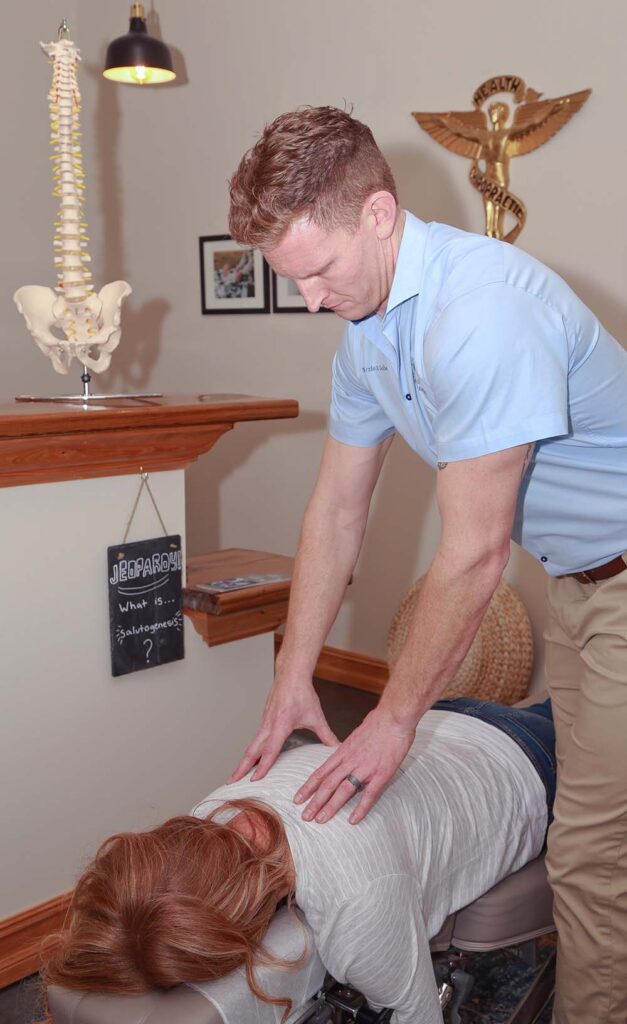
A common worry, especially from people who are nervous about chiropractic, is the manual twist-and-crack image of an adjustment. PRS uses a different tool: a handheld instrument that delivers a precise, low-force impulse to a single segment.
The advantage isn’t only comfort, it’s control. According to PubMed, a biomechanical study measuring the three-dimensional motion produced by chiropractic adjusting instruments found that the force characteristics of the device directly affect how the spine moves, and concluded that instruments can and should be tuned to deliver force optimally. In other words, a measurable, adjustable force is a feature, not a shortcut. It lets us match the correction to the person in front of us.
There is also evidence that this kind of instrument-delivered correction produces real physiological change. According to PubMed, a randomized controlled trial of instrument-assisted spinal manipulation applied to the low back found an immediate, widespread reduction in pain sensitivity along with local muscle relaxation. The authors suggested both segmental and central nervous system mechanisms were involved. That nervous-system angle is central to how we think about care at Koru. We are not simply moving bones; we are influencing how the spine and nervous system communicate.
Our Process, Step by Step
Here is how a PRS correction unfolds in our office:
- Full-spine analysis. We capture upright, weight-bearing imaging and motion studies of the whole spine, not just the upper neck, to see where individual segments have lost normal movement.
- Identify dysfunction below C1. Findings are mapped to specific segments below the atlas: the lower cervical spine, the thoracic spine, the lumbar spine, and the pelvis. We direct correction only where the data shows it is needed.
- Deliver a precise, low-force correction. A controlled instrument adjustment is applied to the identified segment, with the force tuned to you and to that segment.
- Re-measure and confirm. We re-assess after the correction to verify the segment responded. We measure, we don’t guess.
Why This Matters For The People We Serve
For the patient who has “tried everything,” a full-spine method means we are far less likely to miss the segment that actually matters. For the data-driven skeptic, it means decisions are tied to measurements you can see, not to a clinician’s guess. And for anyone who finds the idea of a forceful adjustment unsettling, a tuned, instrument-delivered correction is a gentler path to the same precise goal.
It is also why our care holds up. Correcting C1 in isolation while ignoring a thoracic segment that has lost motion is like aligning the front wheels of a car and ignoring the back. The whole structure has to be measured and addressed for the result to last.
Frequently Asked Questions— Pierce Results System in Louisville, CO
No. We are dual-certified in NUCCA and the Pierce Results System. NUCCA addresses the atlas (C1) at the top of the spine. PRS lets us measure and correct segments below the atlas through the rest of the cervical spine, the thoracic spine, the lumbar spine, and the pelvis. The full-spine picture is how we get lasting results rather than chasing one bone.
It is a measured, instrument-assisted chiropractic method that uses imaging and motion analysis to locate spinal segments that have lost normal movement, then delivers a precise low-force correction to those specific segments. It is built around objective findings and re-measurement rather than guesswork.
Yes. PRS uses a controlled, instrument-delivered force rather than a manual twisting or cracking maneuver. The instrument is tuned to the patient and the segment being corrected, which makes it a good fit for people who are nervous about traditional manual adjusting.
An adjusting instrument delivers a repeatable, measurable force to a single segment, which supports the precise, data-driven approach PRS is built on. Research on adjusting instruments shows their force can be tuned to deliver a correction optimally, so we can match the amount of force to each person rather than applying one technique to everyone.
Koru Chiropractic is in Louisville, Colorado, serving Louisville, Boulder, Broomfield, Lafayette, Superior, and the greater Denver metro area. We are one of roughly a dozen practices worldwide holding dual NUCCA and PRS certification.
See Where Your Spine Has Lost Motion
If you have been adjusted before and the results never seemed to hold, the missing piece may be everything below C1. We would be glad to measure it. Call our Louisville office or submit a form to request a free consultation. We will walk you through exactly what a full-spine analysis would look like for you.
References
- Schneider M, Erhard R, Brach J, Tellin W, Imbarlina F, Delitto A. Spinal palpation for lumbar segmental mobility and pain provocation: an interexaminer reliability study. Journal of Manipulative and Physiological Therapeutics. 2008;31(6):465–473. doi: 10.1016/j.jmpt.2008.06.004
- Christensen HW, Vach W, Vach K, Manniche C, Haghfelt T, Hartvigsen L, Høilund-Carlsen PF. Palpation of the upper thoracic spine: an observer reliability study. Journal of Manipulative and Physiological Therapeutics. 2002;25(5):285–292. doi: 10.1067/mmt.2002.124424
- Keller TS, Colloca CJ, Moore RJ, Gunzburg R, Harrison DE, Harrison DD. Three-dimensional vertebral motions produced by mechanical force spinal manipulation. Journal of Manipulative and Physiological Therapeutics. 2006;29(6):425–436. doi: 10.1016/j.jmpt.2006.06.012
- Yu X, Wang X, Zhang J, Wang Y. Changes in pressure pain thresholds and basal electromyographic activity after instrument-assisted spinal manipulative therapy in asymptomatic participants: a randomized, controlled trial. Journal of Manipulative and Physiological Therapeutics. 2012;35(6):437–445. doi: 10.1016/j.jmpt.2012.07.001