
 Reviews
 Why Advanced Imaging Changes Chiropractic Outcomes
Most people assume chiropractic adjustments are based on feel. A chiropractor examines the spine, finds restriction, and adjusts the area. And while experienced hands matter, modern research suggests something important: precision improves outcomes.
When care is guided by measurement instead of estimation, results become more consistent, more conservative, and more predictable. That’s why advanced imaging — especially 3D spinal imaging — is becoming increasingly important in corrective chiropractic care. Contact us today to see how our advanced imaging can help you!
The Spine Is a 3D Structure — Not a Flat Diagram
The human spine does not move in a single plane.
It rotates, tilts, translates, and adapts in three dimensions simultaneously. Yet many spinal evaluations rely on two-dimensional assessment — either visual posture analysis or standard 2D X-rays. While these tools are useful, they can miss subtle rotational asymmetries that affect neurological loading. Research in spinal biomechanics confirms that even small alterations in cervical alignment can significantly change load distribution and neural stress patterns. When those patterns aren’t measured accurately, care becomes approximation. And approximation produces inconsistent results.
Why Measurement Matters in Neurological Care
The upper cervical spine houses critical neurological structures, including the brainstem and major vascular pathways. Because of this, small positional changes in this region can have disproportionate functional effects. Studies examining sensorimotor integration show that cervical joint position and proprioception strongly influence balance, posture, and central nervous system processing. When alignment is measured precisely, adjustments can be delivered with minimal force and maximal accuracy.
Precision is not about stronger adjustments. It’s about clearer neurological input.
What CBCT Imaging Adds
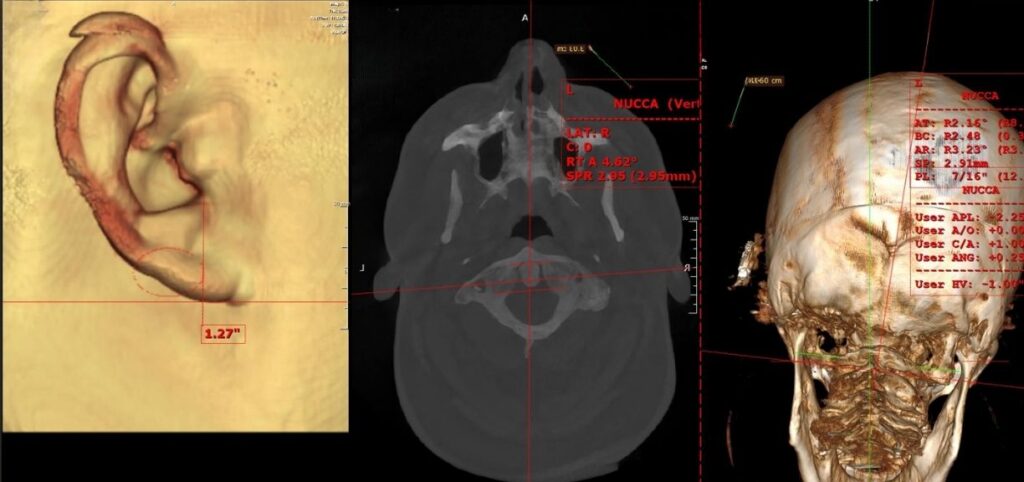
Cone Beam Computed Tomography (CBCT) allows clinicians to view the spine in 3D rather than inferring structure from flat projections.
This matters because:
- Rotational asymmetries become visible
- Joint relationships can be measured
- Structural adaptation patterns can be mapped
- Correction can be planned instead of being guessed
In imaging research, CBCT has demonstrated high spatial accuracy for skeletal analysis and has become a preferred method for precise anatomical measurement in dental and craniofacial medicine. While originally adopted in dental and maxillofacial imaging, its biomechanical accuracy makes it valuable for spinal analysis when used responsibly.
Precision Reduces Force — Not Increases It
A common misconception is that more technology leads to more aggressive treatment. In reality, measurement allows care to become more conservative. When exact alignment is known, the adjustment can be smaller, gentler, and more targeted.
Research into spinal manipulation suggests that neurological effects are related more to specificity and sensorimotor input than raw mechanical force. This supports a shift toward precision-driven care models rather than repetitive high-force interventions.
Why Guessing Leads to Inconsistent Results
When spinal care is based primarily on symptom location, treatment tends to follow pain instead of addressing the pattern. Pain fluctuates. Patterns persist.
Without measurement, the underlying structural adaptation may never be fully corrected, which is why many people experience:
- Temporary relief
- Recurring symptoms
- Plateaued progress
Chronic musculoskeletal conditions are strongly associated with persistent sensorimotor adaptation in the nervous system. Changing that adaptation requires consistent, accurate input — not trial-and-error adjustments.
A Measurement-Driven Corrective Model
At Koru Chiropractic, imaging isn’t used for novelty. It’s used for clarity.
We evaluate:
- Postural adaptation
- Structural asymmetry
- Upper cervical alignment
- Neurological stress patterns
Then we apply gentle, specific corrections designed to change how the nervous system processes alignment. The goal isn’t endless treatment. The goal is stability. Measurement allows correction to become efficient rather than repetitive.
The Takeaway
Advanced imaging doesn’t replace clinical skill. It enhances it.
When the spine is measured accurately:
- Guessing decreases
- Force decreases
- Precision increases
- Outcomes stabilize
And stability is what patients are actually seeking.
Ready to Learn More?
If your symptoms have been inconsistent, or care has helped but never held, the issue may not be effort — it may be measurement. See how Koru Chiropractic can help you. Clarity is the first step toward correction.