
 Reviews
Forward Head Posture: Causes, Fixes, When to Measure
Forward head posture is when the head sits ahead of the shoulders instead of stacked over them, most often from long hours looking down at screens, desks and steering wheels. Many cases improve with posture changes and targeted exercises, and when the structure of the neck is part of the cause, measured chiropractic correction can help too.
I’m Dr. Norris Golberg, a NUCCA Level 2 certified chiropractor in Louisville, Colorado. This page covers how to tell if you have forward head posture, what causes it, whether it can be fixed, what you can do at home, and when it is worth being measured.
How to Tell if you Have Forward Head Posture
Stand with your heels and back against a wall, relaxed, looking straight ahead. If the back of your head does not rest against the wall unless you tilt your chin up, your head is probably sitting forward. A side-on photo works too: in a neutral position, the ear sits roughly over the middle of the shoulder. Either check is a clue, not a diagnosis. Measurement is what confirms it.
Why Forward Head Posture Matters
An adult head weighs about 10 to 12 pounds. As it moves forward of the shoulders, the muscles at the back of the neck and upper back work harder to hold it up. A 2014 biomechanical analysis by a spine surgeon estimated that the load on the cervical spine rises steeply as the head tilts forward (Hansraj, Surgical Technology International, 2014).
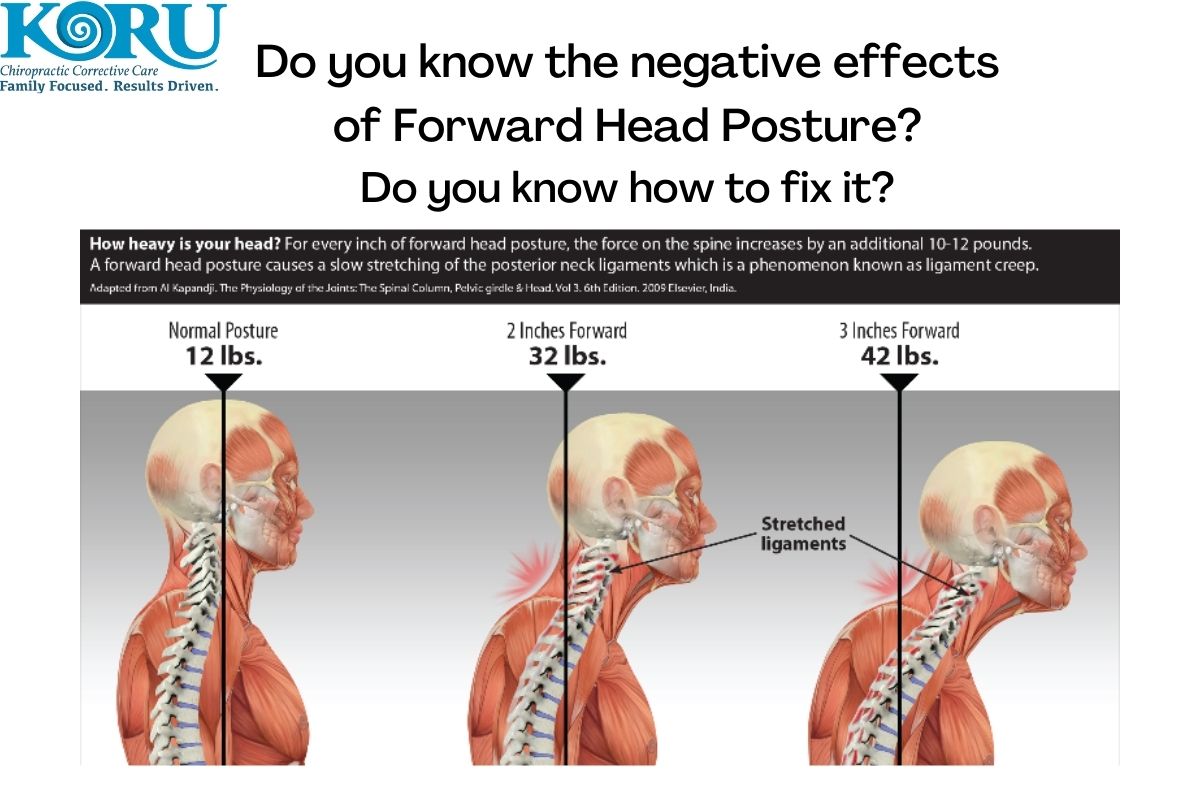
Over time those muscles tire, the posture becomes the default, and people commonly report neck and shoulder tension, headaches and stiffness. That is the pattern I see most in the office.
What Causes Forward Head Posture?
- Screens held below eye level: phones, tablets and laptops.
- Long hours at a desk or behind the wheel.
- Weak deep neck muscles and a tight upper back, which let the head drift forward.
- An old injury, such as whiplash or a fall, that was never evaluated.
- A misalignment at the top of the neck, where the body can compensate by shifting the head forward.
Gravity is always acting on the spine, and most of us can’t hold ideal posture all day. Think of it like brushing and flossing: the more sugar in the day, the more care the teeth need.
Can Forward Head Posture be Fixed?
Often it can be improved, particularly when it is recent and driven by habit. Early on, muscles and habits do most of the work, and they respond. After years, the joints and discs can adapt to the position, and degeneration may be part of the picture. Reversing degeneration is not something I promise, but it is something worth slowing down, and slowing it down starts with knowing where the structure stands today.
Straightening teeth is a fair comparison. You get checked regularly, adjusted as needed, and wear a retainer afterward so the position holds. Chiropractic corrective care works the same way. In Koru’s Corrective Care Approach, the first phase corrects, the second stabilizes, and the third protects what was gained.
How long it takes depends on how long the posture has been there and what is holding it in place. I don’t give a number before measuring. Re-testing, not the calendar, shows whether the change is holding.
What You Can Do At Home
- Raise screens to eye level, and bring your phone up to you instead of looking down at it.
- Break up sitting. Stand, walk or reset your posture every 30 minutes.
- Chin tucks: sit or stand tall, glide the chin straight back without tilting the head, hold for 5 seconds, and repeat 10 times, a few times a day. Go gently.
- Strengthen the upper back with rows or band pull-aparts, and stretch the chest in a doorway for 30 seconds.
Many more exercises and stretches are in my Spinal Hygiene videos, which you can watch here for free. If an exercise makes symptoms worse, stop. If a few weeks of consistent practice changes nothing, that is the signal to get measured.
When Forward Head Posture is More Than a Habit
If the posture or the symptoms are not changing, something structural may be holding it in place. At Koru, Neuro-Structural Testing measures it: 3D CBCT imaging for how the top of the neck sits (NUCCA), standing digital imaging with motion studies for the areas below C1 (Pierce Results System), and posture and leg-length checks. A correction is recommended only if the measurements call for one, and the measurements are repeated afterward to see whether it holds. If the testing shows we can’t help, I say so and help direct you to a more appropriate provider.
Neck pain after a significant injury, or neck pain with numbness, weakness, trouble walking, a sudden severe headache or changes in vision, needs urgent medical care, not a chiropractic appointment.
If a misalignment at the top of the neck may be part of your picture, start with this checklist: do you have an upper cervical misalignment. Or if you’d like to talk it through, schedule a consultation using the form below.
Frequently Asked Questions
Often, yes. Posture changes, targeted exercises and strengthening help most people, especially when the posture is recent. When it does not change with consistent effort, something structural may be holding it in place, and that is worth measuring. Dr Norris re-tests so you can see whether a change is holding, rather than relying on how it looks in the mirror.
It depends on how long it has been there and what has adapted around it. Early, habit-driven forward head posture is usually changeable. After years, the joints and discs can adapt to the position, and degeneration may be part of the picture. Reversing degeneration is not something anyone can promise, but measuring where the neck stands makes it possible to work on slowing it down.
It depends on how long the posture has been there, what is driving it and how consistently the work is done. Dr. Norris does not give a number before measuring. Re-testing, not the calendar, shows whether the change is holding.
Tech neck, also called text neck, is forward head posture that comes from looking down at phones, tablets and laptops. The position is the same; the name describes the habit behind it. The same checks and the same exercises apply.
Yes. Koru Chiropractic is in Louisville, Colorado, and sees people from Louisville, Boulder, Broomfield, Lafayette, Erie and Superior. Dr. Norris Golberg is NUCCA Level 2 certified and trained in the Pierce Results System. Schedule a consultation with the form on this page.
Koru has more than 300 Google reviews at 5.0 stars, many from people who had tried several providers first.