
 Reviews
The Trifecta: EDS, MCAS, & POTS
If you have received a diagnosis of EDS, POTS, or MCAS, you may have heard of the term “The Trifecta.” This term was coined due to the strong prevalence of these syndromes being diagnosed together. Evidence shows that these issues may contribute to each other, making it common to have to deal with concurrent syndromes. It can be frustrating for patients to receive proper diagnoses and treatment protocols without a proper understanding of what these syndromes are and how they are interconnected.
What is EDS?
• Ehlers-Danlos Syndrome (EDS) is a connective tissue disorder. This affects many systems as connective tissue is everywhere, holding us together. Affected tissue is often hypermobile and has reduced proprioceptive feedback.
Affected systems include:
- Integumentary System (skin, hair, nails, and associated glands) – hyper extensible and fragile skin, poor wound healing
- Musculoskeletal System – hyper mobile joints that may dislocate easily, chronic pain and fatigue from instability and sleep disturbances
- Cardiovascular System – low blood pressure, heart valve issues
- Gastrointestinal System – gastroparesis (delayed stomach emptying), irritable bowel syndrome (IBS), reflux
What is MCAS?
Mast Cell Activation Syndrome (MCAS) is when certain cell mediators (mast cells) are improperly activated. Mast cells play a role in inflammation, the immune system, and wound healing. When improperly activated this leads to an inappropriate release of chemicals that cause the symptoms associated with MCAS, including:
- Integumentary System (skin, hair, nails, and associated glands)- flushing, hives, itching with or without rash
- Cardiovascular System- light headedness, fainting, rapid heart rate, chest pain, unstable blood pressure
- Gastrointestinal System – fatigue, diarrhea, nausea, vomiting, abdominal pain, bloating, gastroesophageal reflux disease (GERD)
- Anaphylaxis – systemic or organ-based
What is POTS?
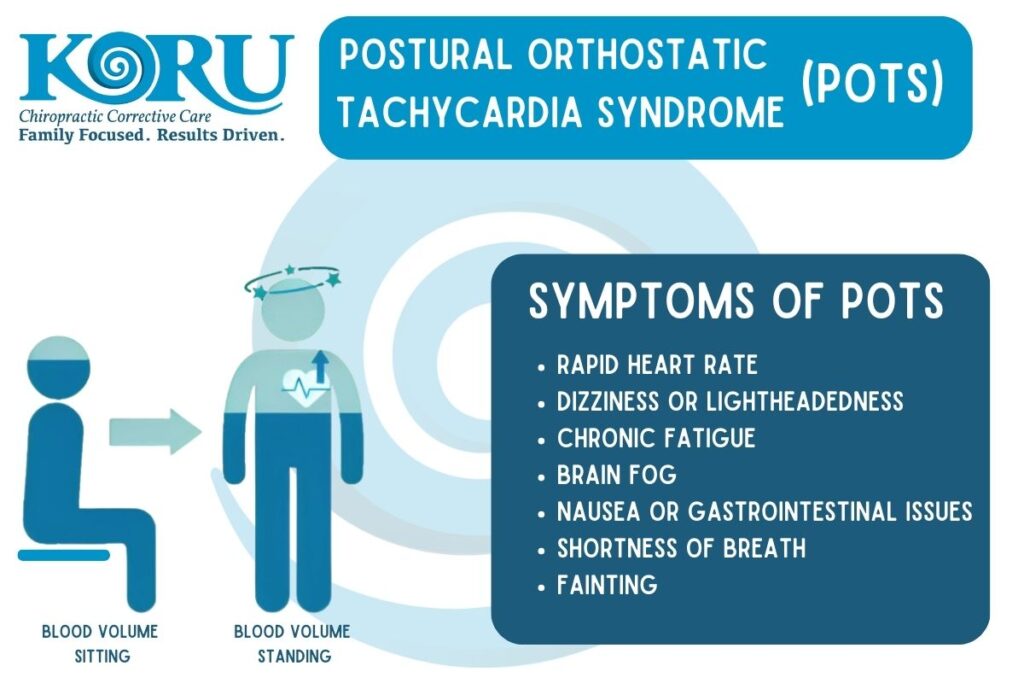
Postural Orthostatic Tachycardia Syndrome (POTS) affects the autonomic nervous system, causing a failure to normalize blood pressure when changing positions, especially when standing up suddenly.
Affected systems include:
Cardiovascular System – heart palpitations and racing (especially with position change), fainting, exercise or heat intolerance, panic attacks
Gastrointestinal System – fatigue, nausea, constipation, diarrhea, gastroparesis (delayed stomach emptying)
Why are these conditions seen together?
These conditions are commonly diagnosed together. About 80% of patients diagnosed with EDS experience symptoms associated with POTS and 31% of people diagnosed with POTS may be diagnosed with EDS [1]. Another study found that 31% of people with MCAS had EDS and POTS [2]. EDS effects a person’s connective tissue. This is because blood vessels which help control your blood pressure are partially made of connective tissue, and so dysfunction of the connective tissue can lead to a reduced ability to regulate blood pressure which is seen in POTS.
Mast cells live in what is called the extracellular matrix, which is connective tissue in-between cells. Altered presentation of this extracellular matrix due to EDS can cause improper activation of the mast cells, leading to MCAS symptoms. These syndromes all have overlapping and similar symptomatology which makes obtaining a proper diagnosis difficult without the help of specialized medical professionals.
Chiropractic care at Koru Chiropractic can help manage symptoms!
At Koru Chiropractic, we utilize two main techniques, an upper cervical technique called NUCCA (National Upper Cervical Chiropractic Association) and the Pierce Results System. Both are low-force, precision-based techniques. NUCCA focuses on the atlas (C1) and axis (C2), the vertebrae directly beneath the brainstem and adjacent to the vagus nerve, a key regulator of autonomic function. The Pierce Results System allows us to care for misalignments and subluxations in the rest of the spine. Unlike traditional high-velocity, low-amplitude (HVLA) adjustments, these techniques use gentle, calculated corrections without twisting or “popping” and follow up imaging to help verify results.
EDS
Because EDS causes generalized joint laxity, the upper cervical spine is often a site of instability itself, and as such, can contribute to headaches, dizziness, and nerve irritation. NUCCA and Pierce protocols use detailed imaging and measurement to identify very specific misalignment before making any correction, rather than relying on general manipulation. This approach is well suited to a hypermobile spine where precision matters more than force. Care is usually focused on ongoing postural stability support in patients with EDS.
MCAS
Although chiropractic care is not a direct fix for MCAS, it helps support the nervous system’s ability to self-regulate and adapt. Autonomic dysregulation and chronic physical stress on the nervous system may influence mast cell reactivity, and improving vagal tone supports immune regulation.
POTS
Chiropractic care is a great adjunct to your normal POTS treatment plan. The atlas sits at the craniocervical junction and is close proximity to the brainstem centers and vagus nerve. These pathways are involved in heart rate and blood pressure regulation. Case reports and small case series have described improvement in orthostatic symptoms and include heart rate stabilization and reduced dizziness, following upper cervical correction.
Frequently Asked Questions- EDS, MCAS, & POTS
The first visit is the Consultation — a conversation, not an adjustment. For Louisville patients, we are located right off Highway 36. Boulder patients typically drive 15–20 minutes along US-36. The Consultation is followed at a separate appointment by Neuro-Structural Testing (imaging, postural and neurological assessment) and then a Case Review where findings are presented. Most patients complete these across two to three visits in the first two weeks.
NUCCA focuses exclusively on the atlas (C1 vertebra) using precision imaging and a gentle, non-cracking correction technique. Most general chiropractors use high-velocity adjustments across multiple spinal segments. NUCCA is more specific, more data-driven, and structured around achieving a stable, long-term correction.
It is a measured, instrument-assisted chiropractic method that uses imaging and motion analysis to locate spinal segments that have lost normal movement, then delivers a precise low-force correction to those specific segments. It is built around objective findings and re-measurement rather than guesswork.
You do not need a referral to see a chiropractor. Simply call our office or fill out the form below to make your first appointment. After our initial consultation we can get in touch with your care team to gain additional insight about your case and share details about how our care can support your long term goals.
What to do next
If you’re one of the many patients navigating EDS, POTS, MCAS, or all three, you don’t have to piece together your care alone. Koru Chiropractic offers upper cervical and full spine chiropractic care using the NUCCA and Pierce Results Systems. These gentle techniques are well suited to hypermobile and dysautonomic patients. Reach out to schedule a consultation and find out how we can become a part of your care team.
References
1. https://www.eds.clinic/articles/the-link-betwen-eds-and-pots
2. https://pubmed.ncbi.nlm.nih.gov/33980338/